Operation Sequences
Setup, Run, Inspect, Transfer
Sequential, parallel, and alternate operations. Setup time, run time per piece, and queue time configured per operation and per work center.
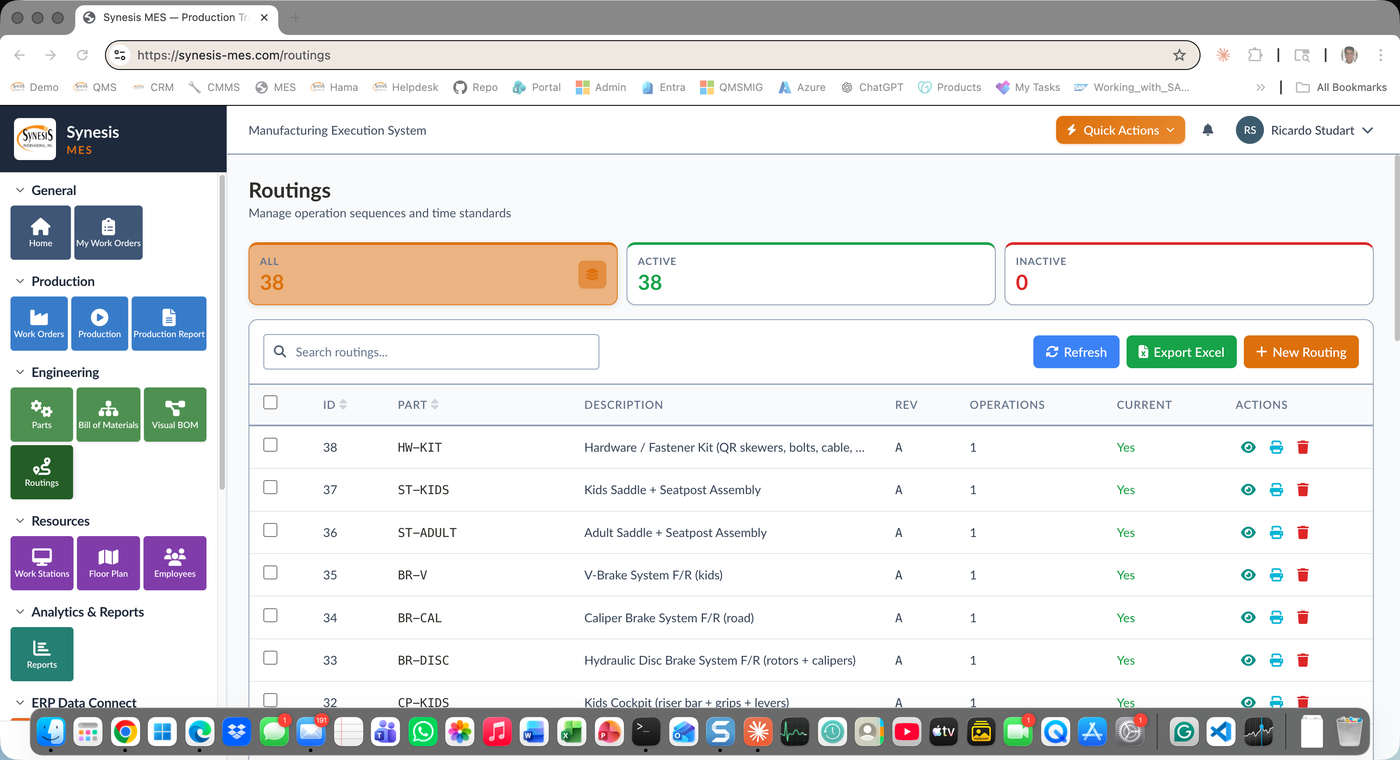
Operation Sequences with Standard Times and Embedded Quality Gates
Synesis MES Routings define how products are made. Each routing is a sequence of operations — setup, run, inspect, transfer, pack — assigned to specific work centers and machines, with standard setup time, run time per piece, and inspection requirements. The routing drives production scheduling, labor capture, capacity planning, costing, and quality.
Operations can be sequential, parallel, or alternate. Quality inspection points are embedded directly in the routing — a routing operation can require pass/fail or measured-value verification before the work order advances. Routings are revision-controlled and tied to BOM revisions through the engineering change workflow.
Setup, Run, Inspect, Transfer
Sequential, parallel, and alternate operations. Setup time, run time per piece, and queue time configured per operation and per work center.
Capacity-Based Scheduling
Operations assigned to work centers (machines, cells, lines). Capacity planning rolls up by work center. Schedule constraints respected.
Earned-Hours Reporting
Setup, run, and teardown standard times per operation. Earned hours computed automatically from production posting. Variance to standard surfaced in real time.
Inspection Embedded
First-piece, in-process, and final inspection points embedded in the routing. Pass/fail or measured-value verification required to advance the work order.
Effective Dating
Routing revisions with effective-from and effective-to dates. In-process work orders complete on their original revision. New work orders pick up the new revision.
Capacity Flexibility
Alternate operations for the same step (e.g., CNC mill A or CNC mill B). System picks based on availability, setup commonality, and load.
Operator-Friendly
At the workstation, operators see the routing operation, work instruction, drawing, and inspection plan for the active step. No paper, no rekeying.
QMS Change Control
Routing revisions flow through Synesis QMS change control with impact assessment, multi-stage approval, and training updates before they release to production.
Capacity planning rolls up by work center. Routing standard times power finite scheduling and order release.
Standard cost = sum of operations × standard times × labor rates. Actual cost from production posting. Variance is the difference.
Earned hours computed from production posting against routing standard times. Operator and shift productivity measured objectively.
Routing-embedded inspection points create a closed loop. Failed inspection stops the work order until QMS disposition.
A routing is the ordered list of operations that turn material into a finished part — the how-you-make-it, operation by operation. Synesis MES routing software defines each operation in sequence, assigns it to a work center, and attaches standard setup, run, and inspection times, so the routing becomes the backbone that drives production scheduling, labor capture, and quality gates. A well-built routing is what lets the plant schedule capacity, measure earned hours, and enforce inspection at exactly the right step.
Each operation carries standard times for setup, run, inspect, and transfer, and those standards do double duty. They feed capacity-based scheduling so the system knows how long each work center is committed, and they become the baseline for earned-hours reporting when operators post actual labor against the operation. Comparing earned standard hours to actual hours is how you see which operations are running efficiently and where a routing needs to be re-timed.
Quality gates embed inspection directly into the operation sequence, so a required check is part of the routing rather than a separate step someone might skip. When production reaches a gated operation, the inspection is presented and must be satisfied before the part moves on, and results tie back through the closed loop to the Synesis QMS. That keeps quality inline with production instead of catching problems at the end.
Routings use effective dating so a revision takes over on its effective date without losing the history of what was in force before — critical when you need to show which routing built a given lot. Routing revisions integrate with QMS change control, so an engineering change that alters an operation flows through a controlled approval before it reaches the shop floor. Alternate operations add capacity flexibility for when a preferred work center is unavailable, without going off-process.
See Synesis MES Routings with your operations, your work centers, and your real-world production flow.
Request a Demo